The Exercise–Health Connection
Physical Activity and General Health
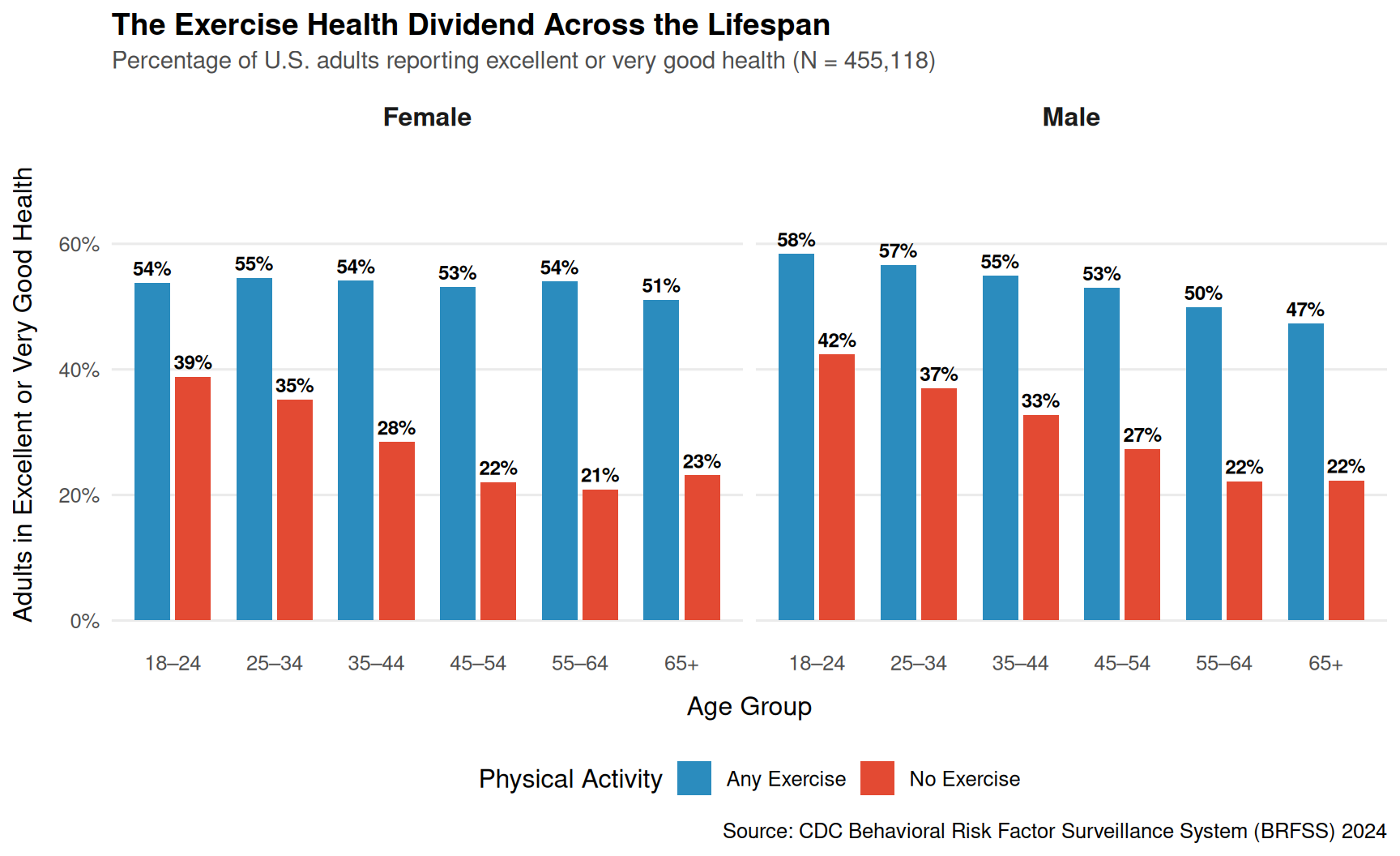
This visualization compares self-reported health between adults who engage in leisure-time physical activity and those who do not, broken down by age bracket and biological sex. The data comes from the 2024 Behavioral Risk Factor Surveillance System (BRFSS), an annual telephone survey administered by the Centers for Disease Control and Prevention (CDC) covering 455,118 adult respondents across all 50 states and U.S. territories.
Across every single age cohort—from young adults aged 18–24 to seniors aged 65 and older—individuals reporting regular physical activity are dramatically more likely to rate their health as excellent or very good. For instance, among adults aged 45–54, over 53% of active men and women report excellent or very good health, compared to only 22–27% of their inactive peers, representing an advantage of more than 25 percentage points.
What makes this pattern especially notable is its persistence across the entire lifespan. While the baseline share of adults in top health naturally declines with age, the relative gap associated with physical activity remains wide and durable. Even among seniors aged 65 and older, more than half (51% of women, 47% of men) of active individuals report good or excellent health, whereas fewer than a quarter of inactive seniors do.
Crucially, these findings demonstrate an association, not causation. Because the BRFSS is an observational cross-sectional survey, it cannot establish whether physical activity directly causes improved health, or whether healthier individuals simply have greater physical capacity and energy to exercise (reverse causation). Unmeasured confounders—such as pre-existing chronic conditions, socioeconomic status, and access to healthcare—also shape both activity habits and self-reported health.
NoteMethodological Considerations & Limitations
- Cross-Sectional Sampling: Because data is collected at a single moment in time, it is impossible to establish temporal precedence between physical activity and health status.
- Self-Reporting Bias: Both exercise frequency and perceived health status are subjective, self-reported telephone responses, which may be subject to recall inaccuracy or social desirability bias.
- Healthy User Effect: Healthier individuals with higher baseline energy or fewer chronic limitations are naturally more capable of maintaining active leisure routines.
- Residual Confounding: Factors such as healthcare access, occupational physical demands, nutrition, and household wealth are not controlled for in simple bivariate stratifications.